
The Traditional Ingredients
Understanding the Traditional Ingredients
The traditional Master Cleanse lemonade is built from four components: fresh lemon juice, maple syrup, cayenne pepper and water.
The ingredient list is short, but each component occupied a particular place within the framework Burroughs described. This article explains what each ingredient is and the role traditional materials attributed to it.
This article documents the historical formula. The explanations traditional materials offered are not modern nutritional or medical conclusions.
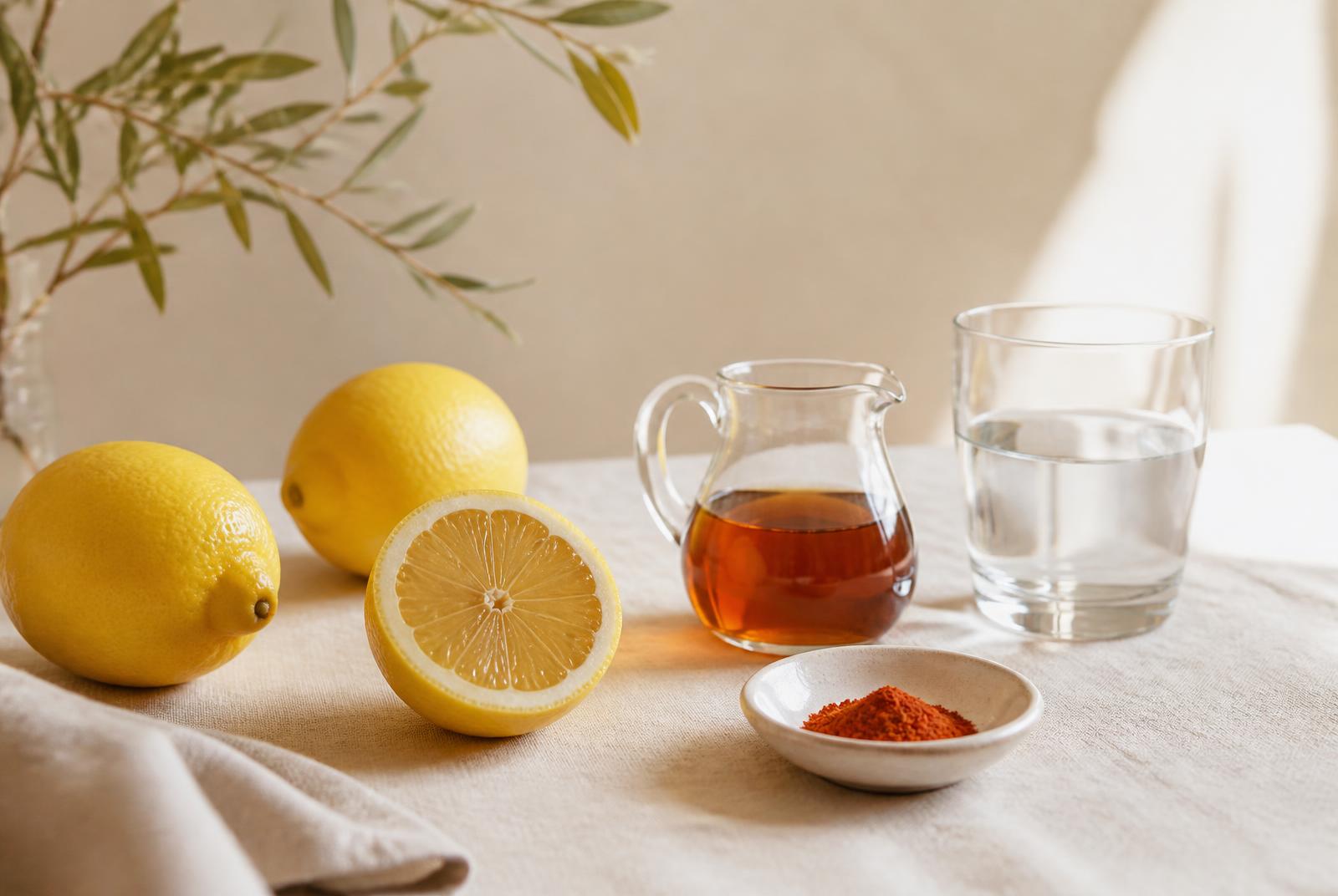
Four Ingredients
A remarkably simple foundation.
Traditional descriptions of the Master Cleanse lemonade rely on four everyday ingredients, combined in consistent proportions.
Below is a brief introduction to each. The sections that follow discuss them individually, and the Classic Recipe remains the reference for quantities, proportions and preparation.
- 01
Fresh Lemon Juice
Juice from fresh lemons, squeezed rather than bottled, forms the base of the traditional beverage.
- 02
Maple Syrup
The sweetening component, described in traditional materials as the source of calories during the lemonade period.
- 03
Cayenne Pepper
Used in a comparatively small quantity, cayenne gives the beverage its characteristic warmth.
- 04
Water
Water dilutes the mixture and determines the final volume of the finished beverage.
01: Lemon
Fresh lemon juice at the center of the formula.
Fresh lemon juice gives the beverage its name, its acidity and its defining flavour. Traditional materials consistently specify juice from fresh lemons rather than bottled or concentrated juice.
Burroughs presented freshness as essential to the practice as he described it, and later accounts have repeated that emphasis. Lemons are also, as a matter of contemporary nutritional fact, a source of vitamin C and citric acid, which is a separate statement from any claim about what the beverage does for a person.
This article does not repeat the explanations traditional materials offered as though they were established findings. What can be said plainly is that fresh lemon juice is the largest flavour component of the traditional mixture.
02: Maple Syrup
The ingredient that provided sweetness, and energy.
Maple syrup is the sweetening component of the traditional lemonade and, in the framework Burroughs described, the source of calories consumed during the lemonade period.
Traditional materials specified pure maple syrup rather than maple-flavoured syrup or other sweeteners. Beyond that, the descriptions attributed particular value to darker syrup, a point that requires a note on terminology, because grading language has changed.
Documenting that historical preference is not the same as claiming that one grade of syrup carries nutritional or health advantages.
A Note on Grading
Older grade names no longer appear on labels.
Historical Master Cleanse materials referred to grades such as “Grade B” or “Grade C” maple syrup, terms describing darker syrup with a stronger maple flavour, typically produced later in the season.
Those letter grades were retired when North American labelling was standardised. Pure maple syrup is now sold as Grade A with a colour-and-flavour descriptor: Golden, Amber, Dark and Very Dark.
In practical terms, the darker syrups historical descriptions referred to correspond most closely to today's Dark and Very Dark categories.
03: Cayenne
A small ingredient with a prominent place in the tradition.
Cayenne pepper appears in the smallest quantity of the four ingredients (typically a pinch per serving) yet it is treated in traditional accounts as an essential part of the formula rather than an optional garnish.
Within Burroughs' traditional framework, cayenne was described as contributing warmth to the beverage and was written about at greater length than its quantity might suggest. Those descriptions belong to the historical material and to the era in which they were written.
This site does not present those historical explanations as established modern medical conclusions. What is documented here is simply that cayenne is part of the traditional formula, in a small amount, and that many people adjust the quantity to their own tolerance for heat.
04: Water
The ingredient that completes the beverage.
Water is the most straightforward component. It dilutes the lemon juice and maple syrup, carries the cayenne through the mixture and sets the final volume of each serving.
Traditional descriptions call for pure water, prepared fresh, and note that the beverage can be made warm or cool according to preference. Nothing further is attributed to the water itself.
It is worth distinguishing this water from other water-related practices described elsewhere in traditional accounts, such as the salt-water practice and herbal tea, which are separate from the lemonade and are covered in the Daily Routine.
Historical Context
Understanding the original before considering variations.
Many adaptations of the lemonade have circulated over the decades: different sweeteners, added ingredients, altered proportions and personal modifications shared through community discussion.
This site's editorial approach is to document the traditional formulation accurately first, so that readers can recognise what the historical materials actually described before evaluating anything presented as a variation of it.
Documenting the original formula is not a claim that it is medically superior, nutritionally complete, or appropriate for every person. It is a record of what the tradition describes.
Editorial Context
Description is not the same as claim.
Ingredient discussions are where historical description and modern health claims are most easily confused. These three categories are kept separate throughout the site.
Historical Description
What Burroughs and traditional materials attributed to an ingredient.
Nutritional Fact
Information that can be supported by contemporary nutritional evidence.
Health Guidance
Questions involving individual health circumstances or professional judgment.
Continue Learning
Continue exploring the framework.
The Fundamentals
What Is the Master Cleanse?
Understand the practice, its origins and how the complete traditional framework fits together.
Continue readingThe History
Who Was Stanley Burroughs?
Learn about the writer most closely associated with the Master Cleanse and the materials it came from.
Continue readingThe Recipe
The Classic Recipe
See the traditional proportions, preparation and the interactive recipe scaler.
Continue readingThe Framework
The 10-Day Guide
See how preparation, the lemonade period and Ease-Out fit together.
Continue readingCommon Questions
Questions About the Master Cleanse
Browse clear answers to frequently asked questions about the traditional process.
Continue readingSee the Ingredients in Context
See how the four ingredients become the traditional lemonade.
The Classic Recipe documents the traditional proportions and preparation, with a scaler for the number of servings you want to reference.